News
Broward County and SFWMD jointly sign Final Integrated Feasibility Report and Environmental Assessment for the C&SF Flood Resiliency Study
July 15, 2026
This spring, Broward County reached a major milestone in partnership with the South Florida Water Management District (SFWMD) with the joint signing of the Final Integrated Feasibility Report and Environmental Assessment for the Central and Southern Florida (C&SF) Flood Resiliency (Section 203) Study. Led by the District and supported by Broward County through a $5 million investment, the study will now be transmitted to U.S. Army Corps of Engineers (USACE) Headquarters for approval and subsequent congressional authorization.
The Section 203 Study represents the first step in a long-term, multi-phased effort to address increasing flood risk across Broward County. By evaluating the impacts of sea-level rise, population growth, and the aging regional flood control system, the study identifies critical infrastructure improvements needed to protect communities, sustain economic growth, and strengthen the county’s resilience for decades to come.
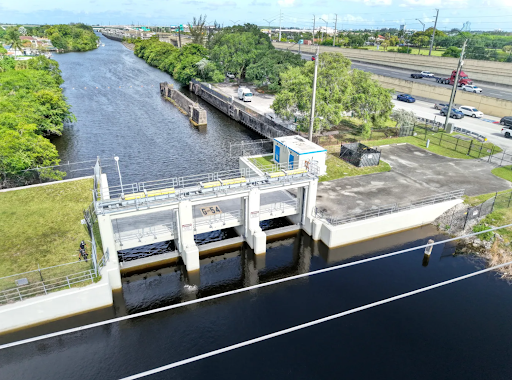
South Florida’s flood protection depends on an extensive network of canals and water control structures managed by the SFWMD. In Broward County alone, this system includes approximately 1,800 miles of canals that move water from the Everglades and western communities eastward to the Atlantic Ocean. Much of this infrastructure was designed and constructed beginning in 1948 and relies on gravity to function effectively, requiring water levels east of each structure to remain lower than those to the west.
As sea levels continue to rise, this fundamental operating principle is increasingly compromised. During storm surge events and even some king tides, water levels on both sides of certain structures become nearly equal, preventing stormwater drainage from western Broward. As a result, rainfall that once flowed efficiently to the coast may instead remain trapped, increasing the risk of flooding in inland communities.
The vulnerability of this aging infrastructure has been recognized for years. In 2009, the SFWMD concluded that 18 of South Florida’s 28 major water control structures were highly vulnerable to failure under projected sea-level rise conditions, including six located in Broward County. Since much of western Broward’s development occurred with the expectation that the canal system would continue providing reliable drainage, the consequences of reduced system performance are significant. With sea levels projected to rise an additional five to 20 inches in the coming decades, implementing the recommendations of the Section 203 Study has become increasingly urgent.
If approved by USACE and authorized by Congress, the recommended improvements would be funded through a cost-share partnership among the federal government (65 percent), the state of Florida, and local governments. The program is estimated to cost approximately $1.8 billion and would be implemented over roughly 12 years, with construction targeted to begin in 2028 and conclude around 2040. Once completed, the improvements are expected to provide flood protection through 2060 and maintain the intended level of service for Broward County’s western metropolitan region while accommodating an additional two feet of projected sea-level rise.
The long-term benefits extend well beyond flood protection. The project is expected to prevent approximately $2.6 billion in property damage, generate an estimated $264 million in economic output during construction through job creation, reduce septic and sewer overflows, help prevent saltwater intrusion into freshwater resources, and lower flood insurance costs by an estimated $146 million.